
10 strongest syndication profiles in crypto media from OMI data [April 2026 list]
Place your content where distribution depth drives meaningful exposure


Sometimes a piece of content appears on one outlet, gets its moment, and then quietly disappears into the stream. Other times, it keeps showing up here and there afterward, and you realize it ended up reaching a lot further than the first run made it seem.
That is essentially what content syndication is: a way of understanding whether coverage stops where it started or keeps opening up new pockets of attention.
Content syndication still drives real results (even if everyone says it’s dead)
A lot of people in PR and marketing circles say syndication is dead because they are thinking of the cheapest, most generic version of it: wire-style distribution that dumps the same press release everywhere, brings in weak leads, creates duplicate-content problems, and burns budget on audiences that were never a fit in the first place.
But that is not really a failure of syndication itself so much as a failure of how it is used.
Done with more intention, syndication can:
stretch the reach of a single placement at literally no cost,
build credibility by putting a brand in authoritative, industry-native spaces,
and even strengthen how that brand shows up in AI answers.
Now it helps to look at the signals Outset Media Index uses to solve the syndication puzzle.
How OMI makes content syndication easier to read
For a long time, one reason syndication was likely to be dismissed is that it was hard to measure properly. If you could not clearly see what happened after publication, you would probably assume the impact was limited.
OMI fits into that gap pretty naturally. We use our own technical infrastructure that turns republication tracking into something much more stable and repeatable. At the core of this infrastructure sits the syndication parser, the first-ever tool that captures how many reprints an article generates and where they appear at the SERP level. Then there is the syndication map, which not only shows the outlets that tend to trigger secondary pickups, but also the pickup paths that can often be anticipated before a campaign even goes live.
However, the raw reprint volume only tells part of the story. We also look at what kind of pickup republications represent, because not every repost carries the same weight. A strong aggregator appearance, a full-copy republication, a lead-and-link pickup, or a low-visibility repost on a dead site do not mean the same thing, so they should not be read the same way either.
From there, OMI makes it clearer when content syndication is actually working and when it is just adding volume:
The Reprints metric shows the lower and upper bounds of how often content from an outlet’s main news section is republished. While some publications barely leave their own orbit, others circulate much further.
The Aggregators field reveals where exactly an outlet’s republications usually appear, which already gives users a practical sense of how that secondary spread plays out.
Alongside these standalone metrics, two corresponding technical scores feed into General Score, making OMI’s overall benchmarking of media outlet performance more objective:
Reprint Score normalizes reprint volume against the quality of the pickup and places the output on a 1–100 logarithmic scale.
Aggregator Score weights the number of aggregator pickups against the quality of those aggregators and presents the result on a 1–10 logarithmic scale.
A lot of this would be messy to track by hand, which is why OMI becomes a go-to platform for engineering visibility and identifying where to place a piece of content to maximize its pickup potential for a specific campaign.
That is the logic behind the list below: ten outlets whose syndication profiles stand out inside the index.
10 crypto media outlets with the strongest syndication
The view below stays close to the syndication layer in OMI, adding a few supporting signals where they sharpen the read.
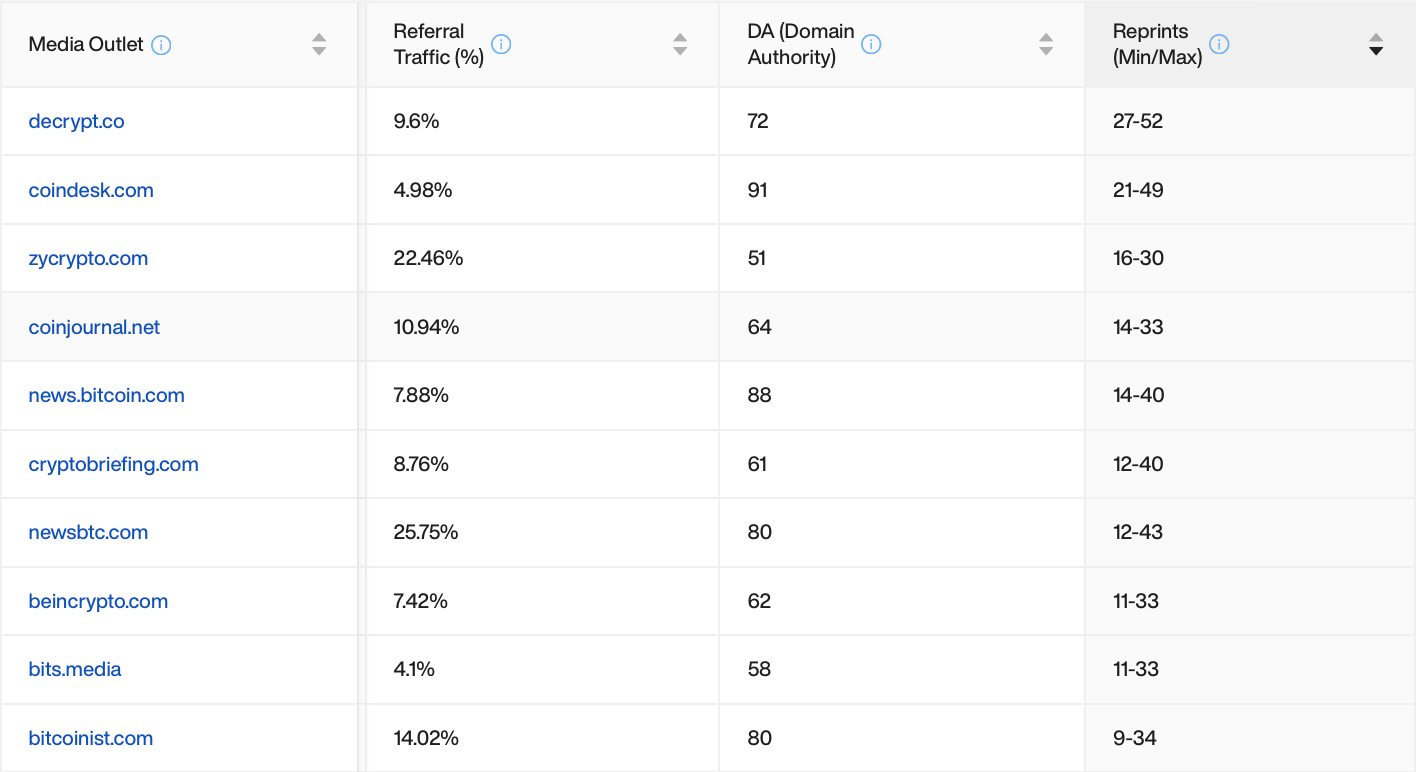
Source: Outset Media Index
1. Decrypt
Overall reprints: 27–52
Top aggregators: Yahoo Finance, CoinGecko, CryptoPanic, and 7 more
Decrypt shows the strongest syndication pattern in the OMI dataset. Notably, this spread plays out across both crypto-native and broader aggregator environments. Put next to total traffic of over 3 million and the highest Composite Score on the list, the signal starts to feel bigger. It points to the most impressive overall momentum across the latest three-month window, which makes Decrypt distinctive not only for how widely its coverage spreads, but also for stable, consistent growth.
2. CoinDesk
Overall reprints: 21–49
Top aggregators: Binance, Bitget, MEXC, and 10 more
While CoinDesk’s reach carries on well past its own homepage, it also draws the largest crypto audience here, with more than 14 million visits recorded in Q1 2026. The outlet’s top Unique Score suggests that this audience is not just big, but genuinely engaged and loyal. That matters for syndication too, because wider pickup is more meaningful when it starts from the main site that already holds that kind of reader base.
3. ZyCrypto
Overall reprints: 16–30
Top aggregators: TradingView, CoinMarketCap, Binance, and 8 more
ZyCrypto’s syndication pattern is still broad, but a little more crypto-native in the way it spreads. The outlet is easier to work with than the bigger names above it. With moderate control over external content, one-day turnaround time, and a lower price point, ZyCrypto comes across as a more practical option without losing its distribution strength.
4. CoinJournal
Overall reprints: 14–33
Top aggregators: CoinGecko, CryptoPanic, Flipboard, and 6 more
CoinJournal’s syndication depth appears good enough to support LLM visibility work. On its own, the outlet has a higher share of AI-driven traffic than Decrypt or CoinDesk. This makes it a cost-efficient but still powerful alternative to tier-1 media brands for campaigns built around that goal.
5. Bitcoin.com News
Overall reprints: 14–40
Top aggregators: CoinMarketCap, Binance, CoinGecko, and 9 more
Bitcoin.com News has one of the stronger upper-end reprint ranges. The longest average visit in the group gives the syndication more substance because it signals that the attention coming in is not just a quick click and exit. Add the outlet’s long-standing industry presence and strong niche authority, and the profile starts to look much more solid.
6. CryptoBriefing
Overall reprints: 12–40
Top aggregators: TradingView, CoinGecko, NewsNow, and 5 more
CryptoBriefing’s syndication appears more persuasive than its size might suggest. With over 370,000 total visits between January and March, the outlet shows healthy referral traffic, the highest AI-driven visibility on the list, and enough link strength to bring your content right into the new discovery layer. The pickup is doing its job of cementing CryptoBriefing’s strategic role in LLM seeding.
7. NewsBTC
Overall reprints: 12–43
Top aggregators: CoinGecko, CryptoPanic, Blockchair, and 7 more
For NewsBTC, syndication is what keeps it looking relevant even as its traffic trend indicates a lasting decline. Over the past three months, site momentum has softened, but the reprint range and aggregator spread have stayed active enough to show that the outlet still holds its place in the regular pickup cycle.
8. BeInCrypto
Overall reprints: 11–33
Top aggregators: Yahoo Finance, CoinGecko, CryptoPanic, and 10 more
BeInCrypto stands out for the combination of syndication strength and exemplary content localization. The outlet runs over 25 language versions on separate subdomains and relies on human writing and translation to ensure a smooth reading experience. Such a profile looks especially well suited to campaigns that need coverage to keep moving across multiple or highly specific markets.
9. BitsMedia
Overall reprints: 11–33
Top aggregators: Yahoo Finance, CoinGecko, CryptoPanic, and 10 more
What makes BitsMedia a different kind of syndication case from the more globally distributed names on the list is that its pickup comes together with regional concentration. Russia generates the largest share of the outlet’s traffic, followed by Kazakhstan and Thailand, which gives BitsMedia a defined center. That changes how the syndication reads: rather than feeling broad in a generic way, it looks tied to a specific audience and market context.
10. Bitcoinist
Overall reprints: 9–34
Top aggregators: Binance, Blockchair, BTCC, and 5 more
Bitcoinist is not only echoed around the ecosystem, but also makes syndication feel more tangible in practice. The pickup is easy to spot and translates into actual audience return. Even if a few publishers here are ahead of Bitcoinist in terms of referral traffic, it gets a bigger share of readers from outside sources than most crypto-native outlets do on average.
What this list hints at
These ten profiles show why it is worth slowing down before reducing outlets to traffic charts and familiar names. The differences here are not cosmetic: one publication may stand out because it is already large, another because it consistently punches above its size, and another because the rest of the profile changes how that syndication should be read.
Outset Media Index brings those differences into view, with more depth sitting behind this list.